Pages

Showing posts with label garden pests. Show all posts

Saturday, March 31, 2012

Neonicitonoids offer LLLOOONNNGGG Term Protection Against Pests

Pin It!

One group of pesticides that I have been devoting more and more time to in my Master Gardener training classes is the neonicotinoids. This group of pesticides received quite a bit of news this past week, as news outlets reported on two studies that link bees' declines with neonicotinoids.

Imidacloprid is perhaps the most common neonicotinoid pesticide available to home gardeners, as it was the first neonicotinoid to gain widespread use (Mullins 1993). Imidacloprid is a systemic insecticide. When applied as a soil drench or soil injection, it is absorbed by the plant's root system, and distributed to different plant tissues via the plant's vascular system. Imidacloprid can also be applied to plant leaves. This is known as a foliar application. In general, soil applications of imidacloprid take longer to work against insects, compared to foliar applications. However, soil applications of imidacloprid are effective for longer, compared to foliar applications.

There are two primary advantages of using a systemic insecticide, such as imidacloprid, against insect pests.
  • First, imidacloprid is highly specific to insects. Imidacloprid is thus less likely to have negative effects on humans and other mammals, compared to other pesticides - such as the organophosphates or carbamates.
  • Second, since soil applied imidacloprid is taken up by the plant's roots and incorporated into plant tissues - by definition - only a pest of that plant will get a dose of the insecticide. An insect has to feed on the plant to get a dose of the pesticide. Sitting on the plant is not enough to get a dose. This is one advantage of soil applied systemics, compared to insecticide sprays. With broad spectrum insecticide sprays, every insect in the path of the spray - whether they are the target pest, or a beneficial lacewing - gets a dose of the insecticide. Systemic pesticides diminish these 'non-target effects'. Of course, there is the issue of systemic insecticides being translocated to the nectar and pollen of plants. I'll cover this issue in a future post. Nonetheless, I'll mention here that one way landscape managers try to reduce the impacts of systemic insecticides on bees is by limiting their application to wind-pollinated trees - such as hemlocks.
Other potential advantages of soil-applied imidacloprid include:
  • They are easier to apply to trees and large shrubs, relative to foliar sprays, and
  • They offer long term protection against pests. In fact, you can often spot those pesticides that are likely to contain imidacloprid as an active ingredient, by looking for phrases such as '12 month control' or 'season long control' on the container.
However, there is much to learn about the long-term persistence of soil applied imidacloprid in trees and shrubs. In fact, the data that is available suggests that long-term persistence may really be LLLLOOONNNNGGGG term persistence.

  • Szczepaniec and Raupp (2007) found that toxicity persisted, and pests were absent, up to three years following the application of imidacloprid to potted cotoneaster. It is important to note that the researchers did not sample foliage or look for pests in year four. They stopped their assays three years following the application of imidacloprid.
  • Cowles and Lagalante (2009) found that a single soil injection to hemlock can provide between 5-7 years of pest protection, and that imidacloprid was detectable up to 8 years after application. After 5 years, the metabolite imidacloprid olefin was more abundant in tree tissue than imidacloprid. Although the authors of this report note that the olefin metabolite is much less toxic than imidacloprid, Nauen et al. (1999) report that the metabolites (including olefine) of imidacloprid retain toxicity to at least some insect pests.
  • Dilling et al. (2010) found that trunk injection of imidacloprid in hemlock trees provided protection against hemlock wooly adelgid for 3-5 years.
  • Webb et al. (2003) also found that a soil drench of imidacloprid protected hemlock trees from hemlock wooly adelgid for almost three years - the extent of the assays in this study.
Now, I'm not writing this post to be anti-pesticide or anti-imidacloprid. In fact, imidacloprid has great potential as a tool that ecologists and land managers can use to save ancient hemlock forests from the invasive insect, hemlock wooly adelgid. This insect is having large-scale, ecosystem level effects that threaten unprecedented hemlock loss (Orwig et al. 2002). If we love hemlocks and hemlock forests, then it makes sense to consider imidacloprid as one tool that can be used against hemlock wooly adelgid, as part of a comprehensive integrated pest management plan. Remember that hemlocks are wind pollinated, thus lessening the potential negative impacts of imidacloprid-treated trees to bees.

Instead, I'm writing this post because I worry that too many home gardeners see the advertisement of '12 month control' on the front of the label, and think 'hmmm . . . . why purchase a product that can give me short term control, when I can get one with really long term control? That seems like the best buy!'

If you are having a short-term, one-time problem with aphids on your rose bushes, I'm not sure that imidacloprid is your best choice. In fact, for short-term, one time pest problems on any plant, I'm not so sure that imidacloprid is the best choice. Thus, I wanted to write a post that points out that the long term protection advertised may be RRREEEEAAAALLLLLlllllyyyyyy long term protection.

It's interesting to note that only one of the studies that I listed (Szczepaniec and Raupp (2007)) looked at the long-term persistence of imidicloprid in an ornamental plant. It's also interesting to note that many of these studies could detect imidacloprid (via bio-assay of pests or chemical assays for the active ingredient) up through their last sampling date. Thus, there is clearly more to learn about the persistence of imidacloprid in home gardens.

Are soil-applied systemic insecticides the best choice for pest problems in the home garden?

Are annual applications necessary?

I can't answer these questions - but I think they're important questions to ask.

Wednesday, March 28, 2012

Do Companion Plants Offer Protection from Insect Pests?

Pin It!

This past week, I attended the Pacific Branch Meeting of the Entomological Society of America (PB-ESA). The meeting was held in Portland, so it was a wonderful opportunity to interact with and learn from entomologists from CA, HI, ID, UT, MT, WA, AZ . . . and of course, OR. What I love so much about scientific conferences, such as the PB-ESA, is that we get a chance to hear about hot and happening research results. Scientific conferences are an opportunity present your work to your scientific colleagues for consideration and critique, before you publish the results of your research.

One talk that really stood out to me was the fantastic work of Joyce Parker. Joyce was examining the efficacy of two ecologically-based pest management practices in broccoli: trap cropping and companion plants.

Trap cropping is a practice where farmers plant a 'trap' crop next to the target crop that they want to protect. Pests are attracted to the trap crop, where they can be managed via targeted chemical controls. The pesticides applied are greatly reduced to a few strips of the trap crop, rather than being broadcast across the larger geographic area of the target crop.

Companion planting
is a practice where farmers plant aromatic crops next to the target crop that they want to protect. The aromas of the companion plants are said to 'hide' the target crop from insect pests. Many gardeners also use companion plants in their garden, by planting marigolds next to marigolds next to cucumbers, or dill next to cabbage.

Joyce's results suggest that using mustard as a trap crop was an effective, ecological pest management strategy in broccoli fields. However, her companion plants (Yukon Gold potato, marigolds, dill, and bunching green onions) didn't protect broccoli from the crucifer flea beetle. Her results align with several others studies which found that companion plants don't mask target crops with their aroma:
  • Finch et al. 2003: cabbage root fly and onion fly were distracted from target crops by the leaf color of some companion plants - but not by the aroma of companion plants.
  • Held et al. 2003: companion plantings of geranium actually INCREASED Japanese beetles on roses. So too did fennel seeds, cedar shavings, crushed red pepper, and osage orange.
  • Latheef and Erwin 1979: cabbage interplanted with peppermint, nasturtium, marigold and/or thyme had just as many caterpillars as cabbage planted with other cabbage.
  • Latheef and Ortiz 1984: hyssop and santolina did not protect cabbage from crucifer flea beetles. Wormwood and tansy reduced crucifer flea beetle numbers by about half (as compared to control cabbage - planted without companion plants). However, damage from crucifer flea beetles was still high on cabbage interplanted with wormword or tansy.
Nonetheless, some gardeners swear by the use of companion plants in the garden. I always tell gardeners that if they feel it's working for them - keep doing what they're doing. Companion plants can be a great way to add color and variety to the vegetable garden. However, if you're planting companion plants purely for the pest control benefits that you've head they might confer . . . you may be disappointed.

Instead, I would suggest planting insectary plants - such as coneflowers, tickseed, bee balm or spirea. These plants have been tested by researchers at Michigan State University and ranked according to their attractiveness to pollinators, parasitoids and predators.

Plants for the Central Coast of Oregon

Yarrow, such as this specimen in the Lincoln County Master Gardener Demonstration Garden, attract a wide variety of beneficial insects when in bloom.

Tuesday, June 14, 2011

The Battle Against Flea Beetles

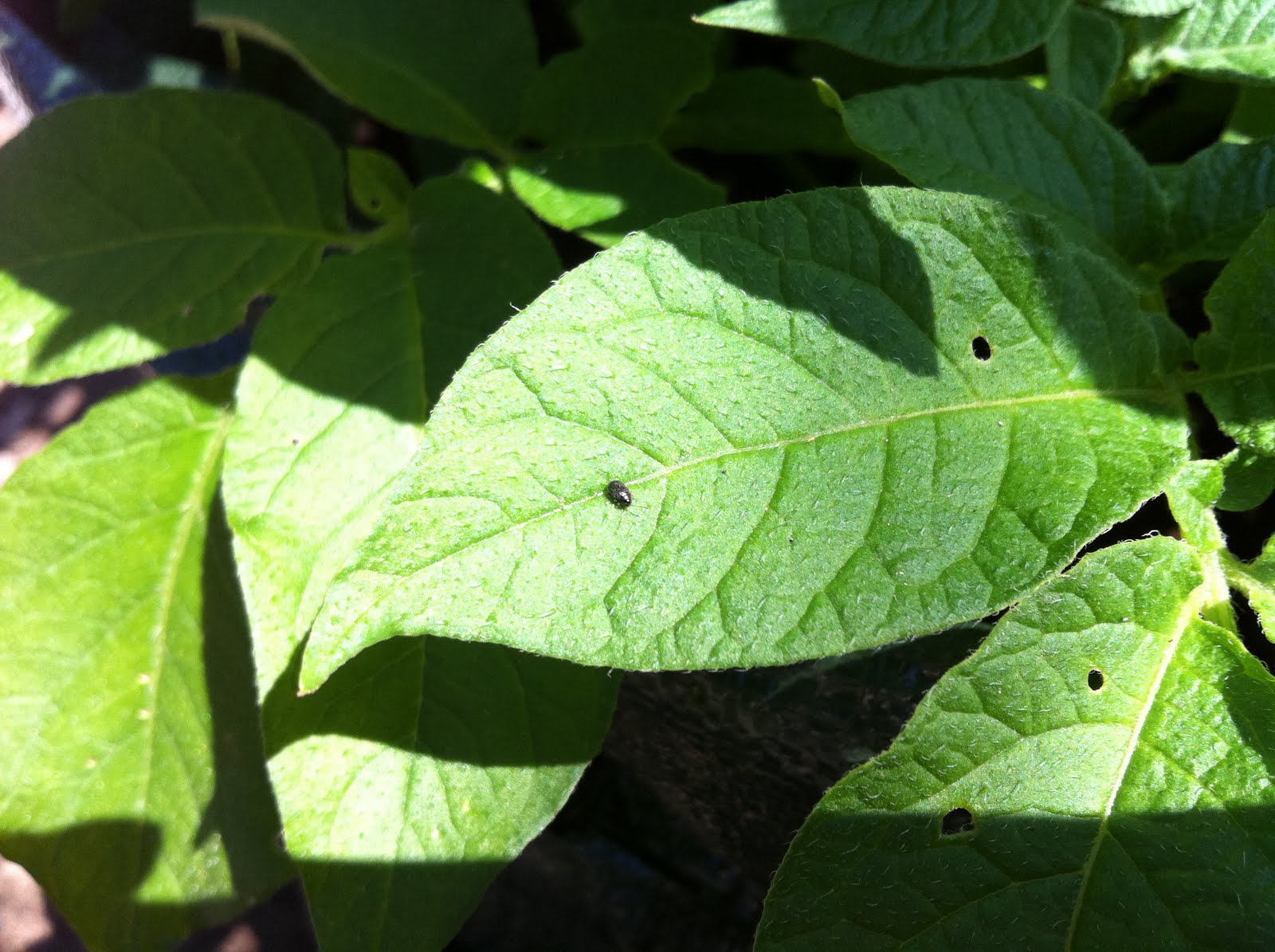
This weekend, I noticed small holes chewed in my potato plants. Whenever I see holes chewed in leaves, I immediately think 'it must be a beetle'. In fact, loopers, armyworms, cutworms and grasshoppers also chew holes in leaf tissue. However, the small, tiny holes in my potatoes were a clear indication that flea beetles were to blame. Flea beetle damage has been described as a leaf looking like it has been shot with several shots from a bb gun (albeit, very small bb's). Whitney Cranshaw describes the damage as looking like the leaves have been hit by fine buckshot - but not knowing what buckshot is, I default to my past experience with bb's. This is very different than the wholesale destruction (often called 'skeletonization') caused by loopers, armyworms and cutworms. It is also different than the large 'chomps' taken from leaves by grasshoppers.

It didn't take me too long to locate the offending chewers. Flea beetles are small and black. When disturbed, they jump off of the leaf much like a flea might jump from a dog. Flea beetles, however, are not blood suckers. They're leaf chewers that locate their host plants using the chemical cues that the plants emit.

Herein lies my problem. I prefer not to use pesticides in the garden. This is a personal preference - due to my being (1) lazy and (2) cheap. I don't like to spend money on pesticides. I don't like to take the time it takes to calculate application rates. Although I love math, I try to keep my garden a math-free zone. Unfortunately, to judiciously use pesticides or fertilizers in the garden requires that I pull out a tape measure - document the area on which I will use the chemical(s) - carefully read the pesticide or fertilizer label - and then translate the area where I will use the chemical(s) to an amount that will come out of the container. I'm just not that motivated.

So what is the problem? Flea beetles are very, very, very, very (you get the idea) difficult to control. They're strong fliers. They locate their host plants by sensing ('smelling') the plants' chemical cues. Worse yet, research strongly suggests that some flea beetles can use the chemical cues in the plants on which they are feeding, to make an aggregation pheromone (Peng and Weiss 1992). This sets the poor gardener (e.g. me) up for failure. One male flea beetle lands on my potatoes and starts to feed. He incorporates the chemical constituents of the leaf tissue, and re-manufactures at least some of these into Axe Body Spray for beetles. Basically, he turns my poor potatoes into his singles bar. No wonder I noticed so many mating beetles on my potatoes this morning, despite my efforts to pick the plants clean just 12 hours earlier. Given this type of chemical wizardry, it would be virtually impossible for me to control the flea beetles by hand-picking them off of the leaves - my preferred pest control method.

Weighing my pest management options, I refer to the PNW Handbook, and look up the entry for flea beetles. The PNW Handbooks are what we use in the Oregon Master Gardener Program, for research-based and reviewed pest control options. The PNWs don't always list the full suite of cultural, physical and biological controls available. But, if chemicals are necessary (which they may be, to control the flea beetles on my potatoes), then the PNWs provide a list of reviewed products. From the list of home use products for flea beetles, I see that neem oil is listed. Neem oil is an organic pesticide that can be used to control a variety of insects and pathogens. Because it is an organic pesticide, it tends to degrade quicker in the environment, relative to synthetic pesticide options. (Please note that organic pesticides are still pesticides. Organic pesticides are not necessarily less toxic than synthetic options, and in some cases are more toxic.)

But, I'm not yet keen to use neem. This is my personal preference, and not my professional recommendation to other gardeners. My own aversion to using chemicals, at this time, is because along with the flea beetles that were feeding on the tops of my potato leaves, I found aphids feeding and giving birth on the underside of the leaves. During Master Gardener training classes, I've often lectured about the benefits of 'popping' aphids. Squish an aphid, and you magically attract parasitoid wasps. Akin to how male flea beetles can use a plant's chemistry to attract the ladies, parasitoid wasps are able to 'smell' the chemicals that are released when an aphid is crushed. Some species of aphids release alarm pheromones when they are crushed. The alarm pheromones send a signal to nearby aphids: 'Abandon ship! We've been found! Parachute to safety, or else be eaten!'. The cool thing about alarm pheromones is that parasitoid wasps, ladybugs and other aphid enemies can hone in on a group of aphids, using released alarm pheromones as a guide (Micha and Wyss 1996). Yesterday, I crushed aphids. Today, I found parasitoids crawling all over my potatoes. A coincidence? Probably not.

So I'm left with potato plants that are infested with flea beetles, and that also have a few aphids (the bad guys). But, these same plants have parasitoid wasps and ladybug eggs (the good guys).

I want to get rid of the bad guys, and will most likely need a chemical solution to take care of the flea beetles. But, even the organic option - neem oil - is known to have negative effects on parasitoids, ladybugs an other natural enemies (Lowery and Isman 1995). The same is true for other insecticides listed for control of flea beetle.

What will I do? Because: (1) my potato plants are relatively large, (2) my tolerance for damage is high, and (3) my aversion to garden math during non-working hours is even higher - I will continue to vigilantly hand pick pests off of my plants. But, if I appear to be losing the hand-picking battle, I'll pull out my calculator, work through garden algebra, and judiciously apply a pesticide on affected leaves. I'll follow label directions, will continue to scout my plants, and will turn to floating row covers to keep the beetles off of my plants while they're looking for places to feed and mate. Once the flea beetle danger has passed, I'll remove the row covers, and look forward to harvesting healthy spuds in the fall. Although, it's hard to predict when the flea beetle danger may pass, since there can be 2-3 generations per year in Western Oregon.

Wish me luck!

Figures

Top: Flea beetle and flea beetle damage (photo taken by: Gail Langellotto)
Middle: Parasitoid wasp (photo taken by: Gail Langellotto)
Bottom: Ladybug eggs (photo taken by: Steve Rhodaback)


References Cited

Lowery, D.T. and M.B. Isman. 1995. Toxicity of neem to natural enemies of aphids. Phytoparasitica 23: 297-306.

Micha, S.G. and U. Wyss. 1996. Aphid alarm pheromone (E)-B-farnesene: a host finding kairomone for the aphid primary parasitoid Aphidius uzbekistanicus (Hymenoptera: Aphidiinae). Chemoecology 7: 132-139.

Peng, C. and M. J. Weiss. 1992. Evidence of an aggregation pheromone in the flea beetle, Phyllotreta cruciferae (Goeze) (Coleoptera: Chrysomelidae). Journal of Chemical Ecology 18: 875-884.