Pages

Showing posts with label ecological gardening. Show all posts

Tuesday, March 19, 2013

Biodiverse Gardens are More Pleasing to the Eye

Despite publishing a scientific paper entitled 'Small scale additions of native plants fail to increase beneficial insect richness in urban gardens', I really am a huge fan and proponent of native plants and biodiverse gardens.  I just have a sense that the benefits of native plants (especially smaller shrubs and annuals) are oversold to home gardeners.  Not all native plants will use less water, better resist pests, or best attract wildlife.  And, gardeners are often left with the impression that they can install a few native plants to support local wildlife.  However, our results suggest that additions of 200-250 plants would be needed, to increase bee, butterfly or beneficial wasp richness by one species.

Given that a few plants won't yield strong benefits to native biodiversity, what type of gardening approach can help conserve wildlife?

A new paper by Petra Lindemann-Matthies and Thomas Marty (Does ecological gardening increase species richness and aesthetic quality of a garden.  Biological Conservation Volume 159,March 2013, pp 37-44) provides strong evidence that a whole gardening approach gets results.

They surveyed 36 gardens in Zurich, Switzerland, and scored them for the presence or absence of the following ecological features: 

  • ponds (provide habitat for amphibians, aquatic insects, aquatic plants)
  • flower meadows (provide nectar and pollen to a variety of beneficial insects, and host rodents that are food for birds)
  • dry walls (provide nesting sites for beneficial insects, or insects that birds feed upon)
  • nettle plots (provide nectar and pollen to a variety of beneficial insects)
  • nesting sites for wild bees and birds
  • decomposing piles of wood (provide habitat and nesting sites for a variety of beneficial insects)
and the following gardening practices:
  • frequency of lawn mowing
  • use of synthetic fertilizers
  • use of pesticides
  • frequency of weeding
Bee House
A 'bee barn' at the Marion Garden in Salem, OR.
Marion Gardens
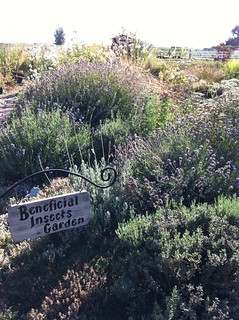
Beneficial Insect Garden at the Marion Garden ~ a demonstration garden of the Marion County Master Gardeners.
They created an 'ecological gardening' score for each garden, by assigning a '1' to beneficial practices (e.g. rarely or never using pesticides) and a 0 to non-beneficial practices (regular use of pesticides).  They then counted the number of plant, fungal and animal species within each garden.

Here is the good news!  Gardens with a higher 'ecological score' were more biodiverse, took less time to manage, and were judged more aesthetically pleasing by neighbors, compared to gardens with a lower 'ecological score'.

In fact, 67% of the variation in biodiversity among gardens was a result of the 'ecological gardening score'.  Only 35% of the variation in aesthetics was a function of the ecological score of each garden, which suggests that ecologically-friendly gardening practices have more of a positive impact on biodiversity, than on aesthetics.

You can learn more about ecological gardening practices by visiting Linda McMahan's ecogardening website, or by visiting an OSU Extension Master Gardener demonstration garden.  Locate the garden nearest you by visiting our Google Map of OSU Extension Master Gardener activities.

View OSU Extension Master Gardener Map in a larger map

Wednesday, March 28, 2012

Do Companion Plants Offer Protection from Insect Pests?

Pin It!

This past week, I attended the Pacific Branch Meeting of the Entomological Society of America (PB-ESA). The meeting was held in Portland, so it was a wonderful opportunity to interact with and learn from entomologists from CA, HI, ID, UT, MT, WA, AZ . . . and of course, OR. What I love so much about scientific conferences, such as the PB-ESA, is that we get a chance to hear about hot and happening research results. Scientific conferences are an opportunity present your work to your scientific colleagues for consideration and critique, before you publish the results of your research.

One talk that really stood out to me was the fantastic work of Joyce Parker. Joyce was examining the efficacy of two ecologically-based pest management practices in broccoli: trap cropping and companion plants.

Trap cropping is a practice where farmers plant a 'trap' crop next to the target crop that they want to protect. Pests are attracted to the trap crop, where they can be managed via targeted chemical controls. The pesticides applied are greatly reduced to a few strips of the trap crop, rather than being broadcast across the larger geographic area of the target crop.

Companion planting
is a practice where farmers plant aromatic crops next to the target crop that they want to protect. The aromas of the companion plants are said to 'hide' the target crop from insect pests. Many gardeners also use companion plants in their garden, by planting marigolds next to marigolds next to cucumbers, or dill next to cabbage.

Joyce's results suggest that using mustard as a trap crop was an effective, ecological pest management strategy in broccoli fields. However, her companion plants (Yukon Gold potato, marigolds, dill, and bunching green onions) didn't protect broccoli from the crucifer flea beetle. Her results align with several others studies which found that companion plants don't mask target crops with their aroma:
  • Finch et al. 2003: cabbage root fly and onion fly were distracted from target crops by the leaf color of some companion plants - but not by the aroma of companion plants.
  • Held et al. 2003: companion plantings of geranium actually INCREASED Japanese beetles on roses. So too did fennel seeds, cedar shavings, crushed red pepper, and osage orange.
  • Latheef and Erwin 1979: cabbage interplanted with peppermint, nasturtium, marigold and/or thyme had just as many caterpillars as cabbage planted with other cabbage.
  • Latheef and Ortiz 1984: hyssop and santolina did not protect cabbage from crucifer flea beetles. Wormwood and tansy reduced crucifer flea beetle numbers by about half (as compared to control cabbage - planted without companion plants). However, damage from crucifer flea beetles was still high on cabbage interplanted with wormword or tansy.
Nonetheless, some gardeners swear by the use of companion plants in the garden. I always tell gardeners that if they feel it's working for them - keep doing what they're doing. Companion plants can be a great way to add color and variety to the vegetable garden. However, if you're planting companion plants purely for the pest control benefits that you've head they might confer . . . you may be disappointed.

Instead, I would suggest planting insectary plants - such as coneflowers, tickseed, bee balm or spirea. These plants have been tested by researchers at Michigan State University and ranked according to their attractiveness to pollinators, parasitoids and predators.

Plants for the Central Coast of Oregon

Yarrow, such as this specimen in the Lincoln County Master Gardener Demonstration Garden, attract a wide variety of beneficial insects when in bloom.