Pages

Showing posts with label vegetable gardening. Show all posts

Wednesday, August 15, 2012

Gardening Increases Fruit and Vegetable Consumption in Children

I rarely say that I'm proud of my work.  Often, my work is collaborative, so that it just doesn't seem right for me to take credit for a job well done.  Even more often, I focus on flaws rather than successes. 

But today, I can honestly say that I'm proud of my work.  Specifically, I'm proud of an article I recently wrote and published with my graduate student.
This is not the first article I've published, but it may be the first one that I literally want to share with just about everyone!  [Right about now, you should be thanking me for not talking about my past work on the mating habits and reproductive fitness of wing-dimorphic planthoppers.  Fun study.  Not a zippy cocktail party topic.]

I decided to write this article while contracted to work on another project.  Growing Healthy Kids is an OSU Extension nutrition education curriculum that uses gardening as a vehicle to teach healthy habits.  I was thus somewhat sad to see that a lot of the gardening activities I included in this first version of the curriculum had been edited out of the final product.  Actually, I was really, really sad.

One reason that gardening was edited out, was because rules governing USDA SNAP-Ed programs didn't allow gardening to be the focus of nutrition education programs - at least - not to the extent that I had written gardening into the curriculum.  Thankfully, the guidelines have changed for 2013, to allow for greater use of gardening in nutrition education programs.  And, right on time, we're set to publish version 2.0 of the Growing Healthy Kids curriculum this October - chock full of garden activities!

A second reason that many gardening activities were edited out of Growing Healthy Kids, version 1.0 is OSU's commitment to research-based practices.  OSU Extension - like Extension Services at Land Grant Universities around the nation - has a strong commitment to research-based practices.  This is the fantastic thing about Extension Services.  When you go to your local Extension Service office to ask for advice on gardening - we focus on research-backed methodologies, rather than simply giving you an opinion.

"It worked this way in my garden.  You should try it, too!" is not a suitable answer.  We instead look for those options that have been tested and supported by rigorous research.

However, when I originally wrote Growing Healthy Kids, the research on whether or not garden-based programs increased fruit or vegetable consumption was mixed.  A few studies showed a positive effect of gardens on changes in fruit and vegetable consumption.  Many studies showed no effect.

Enter my 'aha' moment.  I haven't had many 'aha' moments in my life, and thus want to highlight this one instance in bold type!

I realized that at least part of the reason many researchers have not been able to show a significant, positive impact of gardens (or any nutrition education program, for that matter) on fruit or vegetable consumption is because there is a limit to the servings of fruits or vegetables one person can eat.  Researchers are thus left to look for very small changes.

For example, at the beginning of a research study, a student may eat an average of 1 serving of vegetables each day.  By the end of the study, if they eat an average of 2 servings of vegetables per day - that's a really big deal!  They increase their vegetable consumption by 100%!  However, the researcher is left to document that very small shift from 1 to 2.  This difference is small in magnitude - but can have huge, positive implications for the child who doubles their vegetable consumption.

This is what's known as a problem with statistical power - a problem we could circumvent if we conducted a review of the literature, and then subjected the studies that we found to a meta-analysis.  Meta-analysis is a statistical technique, that allows you to combine data from different studies, so long as those studies test the same hypothesis.  Power problem solved.

So, we searched the published, peer-reviewed literature for studies that looked at the impact of nutrition education programs on changes in:
  1. students' nutrition knowledge,
  2. students' preference for fruits or vegetables, and
  3. students' consumption of fruits or vegetables.
We categorized the components of each study, based upon what type of nutrition education program was offered.  Our three categories were:
  1. No nutrition education (control groups)
  2. Nutrition education without gardening (usually, focused on food groups and nutrition labels)
  3. Nutrition education with gardening
We found that nutrition education programs without gardening increased nutrition knowledge - but not fruit or vegetable consumption.

On the other hand, nutrition education with gardening significantly increased both fruit and vegetable consumption - while having no impact on nutrition knowledge.  Kids who garden eat more fruits and vegetables, even if they don't know why they should be eating more fruits and vegetables!

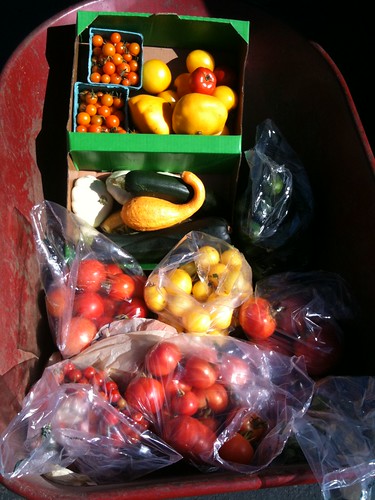
Harvest!
Harvest from Multnomah County Master Gardener Association demonstration garden, at the Learning Gardens Laboratory, 6801 SE 60th Ave., Portland.  Photo submitted as part of a Marje Luce Search for Excellence application, 2012.
Why might this be the case?  We think it may be a combination of two things.  First, kids who garden may have better access to fruits and vegetables.  Second, research by Birch and colleagues (1987) has shown that it takes somewhere between 10-15 'exposures' to a novel food, before kids are accepting of the new food.  Of these 'exposures' at least one of them has to be a taste - but seeing, feeling, growing, smelling are all different ways to expose kids to new foods.  We suggest that gardening is a fun a low risk way for kids to experience vegetables - which makes them more willing to include vegetables they grow into their diet.

So, it may be bold to say - and this was not the focus of our research - but it isn't too great of a leap to suggest that if you teach a kid to garden, you're teaching them to eat healthy!  Go gardeners!


Saturday, April 14, 2012

How Much Does a Vegetable Garden Cost/Save?

Pin It!

NOTE:  UPDATED IN JANUARY 2013 TO REFLECT THE CORRECT GARDEN SIZE (AND ADJUSTED CALCULATIONS) OF ROGER DOIRON'S GARDEN.

Finally!  A day without work to play in the vegetable garden.  My peas are coming up!  The potatoes have poked through the soil.  My seed starts have all sprouted!

Raised Bed Cloche
Raised bed cloches, such as this one in a Master Gardener demonstration garden in Lincoln City, OR, are a great way to get a jump start on the growing season. 

The time I get to spend in the garden is truly a gift.  Even better, my garden is a gift that keeps on giving.  We haven't bought garlic or shallots since we started gardening (I always overbuy and overplant).  My kids don't like to eat peas, unless they're straight from the garden.  Herbs are always clipped from the perennial rosemary and thyme shrubs, out front.  We celebrate with fresh salsa and pesto, when we harvest our cilantro and basil.  And, like many gardeners, we have been known to leave bags of tomatoes and squash on the doorsteps of our unsuspecting neighbors.

Although I am totally sold on vegetable gardening as a way to have more direct control over what my family eats, as well as way to supplement our family food budget - I thought it might be useful to spell out the approximate monetary value of home vegetable gardening.

Thus, I tracked down as many references as I could, that detailed how much it cost to start a vegetable garden, as well as how much their garden yielded.  I came up with 6 studies, that reported 8 observations.  The sources include:
  • James Stephens and colleagues 1980 paper, which was published in the Proceedings of the Florida State Horticultural Society (Volume 93, pages 70-72).  They report on two separate gardens in this paper: one in Tallahassee and a second in Jacksonville.  Time spent in the garden was tracked, and charged at $3.10 per hour.
  • J.D. Roth's Get Rich Slowly blog, where in 2008, he and his wife tracked how much a vegetable garden cost and saved for one year.  They spent a total of 54 hours in their Oregon garden, between their January start date and October harvest.  I did not add in the cost of their labor in their reported costs of $318.43.
  • Stall's 1979 paper published in the  Proceedings of the Florida State Horticultural Society (Volume 92, pages 213-214).  Labor, water and travel costs not included in the reported costs.
  • Roger Doiron's Kitchen Gardeners blog, where he and his wife tracked how much food they could grow over six months in their large, home garden in Scarborough Maine.
  • Cleveland and colleague's 1985 paper, published in HortScience (volume 20, pages 694-696), where they looked at the costs and yields of vegetable gardens in Tucson, Arizona, over 2.5-3.0 years.  Labor costs were included in total cost of establishing and maintaining the gardens.  As you might expect for desert gardens, the greatest cost incurred was the cost of irrigation water.
  • Utzinger and Connolly Harrison's 1978 paper, published in HortScience (volume 13, pages 148-149).  I admit that I didn't read this paper (no electronic access to this paper), but secondarily cite information, as reported in Cleveland et al. 1985. 
For each garden, I looked at the difference between yield and cost (difference = yield - cost).  I adjusted the value of the difference to its 2012 value, using an online Consumer Price Index inflation calculator.  I then divided this adjusted difference by the size of the garden, to arrive at the value per square foot of garden area.
Source Location Size (Square Feet) Cost Yield Difference Difference, Adjusted to 2012 Value Value/Square Foot
Stephens et al. 1980 #1 Tallahassee, Florida 1,400 $70 $384 $314 $874.14 $0.62
Stephens et al. 1980 #2 Jacksonville, Florida 638 $83.00 $416.00 $333.00 $927.03 $1.45
Stall 1979 Homestead, Florida 600 $333.65 $495.70 $162.05 $512.02 $0.85
Doiron 2009 Scarborough, Maine 1,500 $282.00 $2431.00 $2149.00 $2297.80 $1.53
Roth 2008 Oregon 878 $318.43 $606.97 $288.54 $307.42 $0.35
Cleveland et al. 1985 #1 Tucson, Arizona 833 $45.00 $154.00 $109.00 $232.38 $0.28
Cleveland et al. 1985 #2 Tucson, Arizona 627.5 $56.00 $178.00 $122.00 $260.09 $0.41
Utzinger and Connolly Harrison 1978 Columbus, OH 150.7 $46.00 $90.00 $44.00 $154.80 $0.41

Altogether, the gardens had an AVERAGE VALUE OF $0.74 / square foot of garden area, and a MEDIAN VALUE OF  $0.62 / square foot of garden area. 


For a modest-sized garden, 200 square feet in size, that's a return of $148 in the first year.  For larger gardens, 500-700 square feet in size, that's a return of $370-$518 in year one, alone!

In at least 5 out of the 8 observations (all but Cleveland et al. 1985, and maybe Utzinger and Connolly Harrison 1978), the costs incurred included what was needed to establish a garden, and not simply to maintain a garden.  These costs are sure to decrease in subsequent years, as the cost of maintaining a garden is substantially less than start up costs.

Thus, even in the first year after establishment, the net economic benefits of vegetable gardening are positive - and these economic benefits are sure to increase in years two, three and beyond.

The consistent 'winners' in these papers included:
  • salad greens
  • tomatoes
  • beets
  • broccoli
  • potatoes
  • strawberries
These were the fruits and vegetables that yielded the most, in terms of dollars saved by not having to purchase these items.  However, to truly get the best value from your vegetable garden, it is important to plant what your family likes to eat.  No one really liked the green tomatoes (or the pear tomatoes) that I planted a few years ago.  Lesson learned.  I scratched those from my list.

On the other hand, my kids couldn't get enough green peas or kale.  Thus, I am more than accommodating with space for these favored fresh veggies.

To cut our garden start up costs, my husband and I did the following:
  • We compost everything we can for the free soil amendments that composting yields.  Our first year garden was planted in subpar (cheap) soils that we purchased (but we still had a great harvest!).  Years two and three were amazingly productive.  I give credit to the compost.
  • We built raised garden beds out of recycled/reclaimed fencing material.  The fencing material had not pressure treated.  CCA, or copper chromated arsenic treated wood should be avoided -  primarily because of the hazards with handling the wood, rather than the wood contaminating the garden produce.  Other wood types are likely okay.
  • We started gardening with what I like to call the 'starter set of seven' - vegetables that do well with little work, in most home gardens.  My starter set was:  peas, leaf lettuce, summer squash, tomatoes, spinach, potatoes, garlic.
  • We were proactive in our pest management.  I like walking the garden every day, and this helps me catch problems before they grow out of hand.  Cabbage worms in kale?  I hand picked them off, nearly every day.  Slugs clipping my seedlings (which is happening right now)?  Time to pull out the Sluggo.  My husky is eating the peas again?  Ugggh.  Time to fence her out.
  • Kids in the household = free help with weeding.  My kids have come to understand that it takes time and effort to grow our own food.  They normally leave the garden to me - but will help spread wood chips (as a weed-suppressing mulch) or will help hand weed beds - when asked.  I also invite them to plant with me.  At 17 and 15 years old - they take real delight when they see something that they planted and harvested on our dinner plates.  
  • We hand water everything.  A turf professor once told me that he thought watering should be as burdensome as possible, so that folks realized how much water they were using to maintain their lawns and their garden.  I've taken that to heart - and hand water (every day, in the heat of the summer) our vegetable garden, as well as a few ornamentals.  This cuts down on our water use, which cuts down on irrigation costs.
  • We're learning to preserve what we grow, so that there is no waste.  We're still not perfect in this regard (some tomatoes have been known to be worked into the soil at the end of the season, rather than put up in cans).  But, we're getting better, and we accept mistakes.  Gardening should be relaxing, and not one more thing that stresses you out. 


Tuesday, February 22, 2011

Annual OSU Recommended Vegetable Varieties List Released

2-18-11

OSU-recommended vegetables provide best yields in local gardens

By Judy Scott, 541-737-1386, judy.scott@oregonstate.edu
Sources: Annie Chozinski, 541-737-8959, chozinsa@hort.oregonstate.edu
Jim Myers, 541-737-3083, myersja@hort.oregonstate.edu

CORVALLIS, Ore. — Vegetable varieties and melons recommended by Oregon State University for 2011 are adapted to local growing conditions to produce the best yields in home gardens. The OSU Extension Service recommends the updated varieties listed here for all areas of the state except regions indicated.

"We look at these varieties at least two years before we can make recommendations," said Annie Chozinski, faculty research assistant with the horticulture department at OSU.

"Some we consider for many years, especially if they vary from year to year,” she said. “We observe and measure many traits, but it's the overall score that helps us decide. If something has high scores in everything but succumbs to disease pressure, it is not recommended. Similarly, if something is highly disease resistant but has odd flavors, size or variability, we don't recommend it."

Regions:

I. Oregon coast: cool but long season of 190 to 250 days.
II. Western valleys: 150-250 day season; warm days, cool nights; length of season may very considerably from year to year.
III. High elevations: short growing season of 90 to 120 days; frost possible in any month.
IV. Columbia and Snake River valleys: 120- to 200-day season; hot days, warm nights, length of season fairly well defined.


Recommended varieties:

Artichoke
(not regions III and IV) Green Globe, Imperial Star, Emerald.

Asparagus
Mary Washington, Jersey Knight, Jersey Giant, UC 157, Purple Passion.

Beans
(green bush) Tendercrop, Venture, Slenderette, Oregon 91G, Oregon Trail, Provider, Jade, Oregon 54.
(flat Italian) Roma II.
(French filet) Nickel, Straight ‘N Narrow.
(green pole) Blue Lake, Kentucky Wonder, Romano, Cascade Giant, Kentucky
Blue, Oregon Giant.
(wax bush) Goldenrod, Goldrush, Indy Gold, Slenderwax.
(lima, bush, large seeded) Fordhook 242 (or any Fordhook).
(lima, bush, small seeded) Thorogreen, Baby Fordhook, Jackson Wonder.
(dry) Pinto, Red Kidney, White Kidney (Cannellini), Cranberry, Etna.
(edible Soybeans or Edamame) Envy, Early Hakucho, Butterbean, Sayamusume, Misono Green.

Beets
Ruby Queen, Red Ace, Kestrel, Early Wonder, Pacemaker III, Detroit Dark Red, Red Cloud.
(cylindrical) Cylindra, Forono.
(golden) Golden.
(novelty) Blankoma, Chioggia.
(greens) Early Wonder Tall Top, Bull’s Blood.

Broccoli
Premium Crop, Packman, Arcadia, Early Dividend, Windsor, Emerald Pride, Gypsy.
(Romanesco type) Romanesco, Veronica.

Brussels Sprouts
Jade Cross "E", Oliver.

Cabbage
(early) Parel, Primax, Farao, Tendersweet, Gonzales, Surprise.
(main season) Golden Acre, Bravo, Charmant, Cambria, Invento.
(late fall, winter) Danish Ballhead, Storage Hybrid #4, Blue Thunder.
(red) Ruby Perfection, Red Acre.
(savoy) Melissa, Savoy Express, Savoy Ace, Perfection, Famosa.

Chinese cabbage
Michihili, Monument, China Express.
Pac choi: Mei Qing Choy, Joi Choi.

Carrots
Red Core Chantenay, Royal Chantenay, Scarlet Nantes, Mokum, Bolero, Apache, Danvers, Sugarsnax 54, Nelson, Napa, Kuroda, Nantindo, Magnum, Navarino, Sweetness III, Napoli, Yaya, Vitana, Skywalker.
(yellow) Yellowstone.
(white) White Satin.
(purple) Purple Haze.
(baby carrots) Minicore, Parmex, Thumbelina.

Cauliflower
Snowball "Y" Improved, Snow Crown, Candid Charm, Apex, Amazing.
(Purple) Violet Queen, Graffiti.
(green) Panther.
(Romanesco type) see Broccoli.

Chard
Fordhook Giant, Rhubarb, Bright Lights, Bright Yellow, Silverado, Broadstem Green.

Chicory
(green) Crystal Hat (tall, slender heads).
(red, also known as Radicchio) Chiogga Red Preco, Palla Rosa Special, Indigo, Treviso (tall, slender heads).

Celery
Utah 52-70R, Tango.
Celeriac: Brilliant, Diamont.
Collards: Vates, Champion, Flash.

Corn

Yellow Kernels
Standard sweet (early): Sundance, Early Sunglow, Seneca Horizon.
(main season): Jubilee (also called Golden Jubilee).
Supersweet (early): Butterfruit.
(main season): Supersweet Jubilee.
Sugary enhanced (very early): Sugar Buns.
(early): Precocious, Spring Treat.
(main season): Incredible, Kandy King, Kandy Korn, Legend, Bodacious.

White Kernels (must be isolated from yellow or bicolor types to get all white kernels).
Supersweet (main season): How Sweet It Is, Xtratender 378A, Mirai 421W.
Sugary enhanced (early): Sugar Pearl
Sugary enhanced (main season): Argent, Whiteout, Silver Princess.

Bicolor Kernels
Supersweet (early): Xtratender 272A, Mirai 308BC.
(main season): Honey and Pearl, Xtratender 277A.
Sugary enhanced (early): Trinity, Fleet.
(main season): Temptation, Brocade, Delectable, Mystique.
Triple Sweet types (sh2su hybrids): Sweet Rhythm, Serendipity, Sweet Chorus,
Nantasket, Renaissance.

Ornamental
(must be isolated from other corn): Wampum, Chinook.

Note: Kernel quality of all the above corn varieties may be dramatically altered under certain pollination conditions. Supersweets must be isolated from other types.

Cucumbers
(pickling) SMR 58, Pioneer, Bush Pickle, County Fair, Clinton, Cool Breeze, Regal, Vertina.
(slicing) Burpee Hybrid, Marketmore 86 & 97, Poinsett, Raider, Dasher II,
Slicemaster, Intimidator, Tasty Green, Orient Express, Genuine, Sweet Marketmore, Tasty Jade.
(novelty) Armenian, Lemon.

Eggplant
(not regions I, III) Dusky, Epic, Bambino (round), Cloud Nine, Calliope, Burpee Hybrid, Millionaire, Classic, Lavender Touch (white with lavender blush), Dancer (violet).
(elongated) Megal, Bride, Orient Express.

Endive
Green Curled, Batavian, Salad King, Neos.

Gourds
(ornamental) Harrowsmith Select, Little Guys Mix, Corsican, Turk’s Turban, Aladdin, Large Bottle, Goblin Eggs, Autumn Wings.

Kale
Dwarf Blue Curled Scotch, Improved Vates, Siberian, Winterbor, Winter Red, Nero di Toscana, Blue Ridge, Red Bor, Red Ursa.

Kohlrabi
Early White Vienna, Early Purple Vienna, Kongo, Kolibri, Eder.

Leeks
American Flag, King Richard, Kilima.

Lettuce
(heading, main season) Summertime, Ithaca.
(red leaf) Prizehead, Red Sails, Redina, New Red Fire, Merlot, Red Tide.
(green leaf) Salad Bowl, Grand Rapids, Slobolt, Pom Pom.
(oak leaf) Oaky Red Splash, Cocarde, Mascara, Blade.
(romaine) Paris Island, Valmaine, Green Towers, Outredgeous, Devils Tounge, Little Gem, Freckles.
(bibb type) Optima, Buttercrunch.
(butterhead) Esmeralda, Marvel of Four Seasons, Emerald Oak.
(batavian) Nevada, Sierra.

Melons
(not regions I and III)
(Cantaloupe/muskmelon) Ambrosia, Harper Hybrid, Gold Star, Classic, Pulsar, Superstar, Earlisweet, Primo, Fastbreak, Hannah’s Choice, Athena, Earlichamp, Sarah's Choice.
(Honeydew) Earlidew, Honey Orange.
(Galia types) Galia, Passport, Arava.
(Crenshaw types) Early Hybrid Crenshaw.
(Canary) Sugarnut.

Mustard Greens
Green Wave.
(long standing) Osaka Purple, Giant Red.

Onions
(yellow) Copra, Prince, First Edition, New York Early, Candy.
(red) Redwing, Mars.
(white) White Sweet Spanish, Superstar.
(overwintering) Walla Walla Sweet.
(green bunching) Ishikura, Tokyo Long White, He-shi-ko.

Parsley
Triple Moss Curled, Banquet, Dark Green Italian Plain.

Parsnips
Harris Model, All America, Hollow Crown, Gladiator, Andover, Cobham Improved Marrow, Javelin.

Peas
(shelling) Novella II, Oregon Trail, Oregon Pioneer, Green Arrow, Maxigolt.
(oriental edible pod) Oregon Sugar Pod II, Oregon Giant.
(snap pea, bush) Sugar Daddy, Super Snappy, Cascadia, Sugar Sprint, Sugar Ann.
(snap pea, pole) Sugar Snap or Super Sugar Snap (virus susceptible; plant early).

Peppers
(sweet bell, green to red) Parks Early Thickset, Camelot, Fat 'N Sassy, Ace,
Bellboy, Jupiter, Yankee Bell, North Star, Lady Bell, King Arthur, Lantern.
(sweet bell, green to yellow) Golden Bell, Golden Summer.
(sweet bell, green to orange) Ariane, Mandarin.
(sweet bell, green to purple) Lilac Bell, Purple Beauty, Tequila.
(sweet bell, green to lavender to red) Islander.
(sweet bell, green to chocolate) Hershey.
(sweet bell, ivory to red) Ivory.
(specialty sweet types) Sweet Banana, Banana Supreme, Bananarama, Gypsy, Biscayne, Pizza, Lipstick, Apple, Paprika Supreme, The Godfather, Giant Marconi, Round of Hungary, Sweet Cayenne, Carmen, Corno di Toro Yellow.
(cayenne) Super Cayenne II, Andy, Cayenne Long Slim.
(jalapeno) Tam Jalapeno, Early Jalapeno, Conchos, Fresno, Mitla.
(paprika) Mariachi, Paprika Supreme.
(specialty hot types) Cherry Bomb, Serrano, Anaheim TMR23,
Caribbean Red Habanero, Hot Paper Lantern, Bulgarian Carrot, Aji Amarillo.
(novelty, ornamental) Marbles, Riot, Pretty in Purple.

Potatoes
(red) Red Pontiac, Norland, Red La Soda, Cranberry Red.
(white) Russet Burbank, Superior, Goldrush, Kennebec, Butte.
(yellow) Yellow Finn, Yukon Gold, Bintje, Desiree, Red Gold (red skin, yellow flesh),
Carola.
(purple) All Blue.
(fingerling) French Fingerling.

Pumpkins
(large) Jack O'Lantern, Howden, Autumn Gold, Lumina (white), Magic Lantern, Rouge Vif d'Etampes (Cinderella), Rock Star, New Rocket, Sorcerer, Charisma.
(small) Small Sugar (also called Small Sugar Pie), Orange Smoothie.
(compact vines) Tom Fox, Oz, Spirit.
(novelty and exhibition) Big Max, Dill's Atlantic Giant, Prizewinner.
(hulless seeded types) Baby Bear, Snack Jack, Trickster, Kakai.
(mini ornamental types) Jack Be Little, Wee-Be-Little, Lil Pump-ke-mon, Baby Boo.

Radish
(red) Fuego, Comet, French Breakfast, Cherry Belle, Champion, Cherriette, Crunchy Royale, Pink Beauty.
(white) Burpee White, White Icicle.
(large Japanese type) Sakurajima Mammoth.

Radicchio
see Chicory.

Rutabaga
American Purple Top, Laurentian.

Shallots
Bonilla

Spinach
(spring planted for early summer harvest) (smooth leaf) Bloomsdale Long Standing, Olympia.
(savoy) Correnta, Unipack 151, Melody, Hellcat, Butterflay.
(late summer planted for fall harvest) (smooth leaf) Oriental Giant, Bordeaux.

Squash
Summer
(yellow) Early Prolific Straightneck, Multipik, Supersett, Fancycrook, Sunray, Yellow Crookneck, Goldbar, Gentry.
(green zucchini) Ambassador, Seneca, Elite, Tigress, Aristocrat, Raven, Cashflow, Geode (round), Floridor (round).
(yellow zucchini) Gold Rush, Butterstick.
(scallop) Sunburst, Sunny Delight.
(other summer) Tromboncino (C. moschata).

Winter
(not Region 1)
(misc) Golden Delicious, Banana, Blue Hubbard.
(Buttercup/Kabocha) Sweet Meat, Sweet Mama, Ambercup, Buttercup Burgess Strain, Gold Nugget, Black Forest, Autumn Cup, Bonbon.
(Delicata) Sugar Loaf, Honey Boat.
(Acorn) Table Queen, Mesa Queen, Table Ace, Taybelle, Table Gold (orange), Cream of the Crop (white).
(Butternut) Early Butternut, Ultra, JWS 6823.
(Spaghetti) Spaghetti, Pasta, Stripetti, Small Wonder.

Sweet Potato
(not regions I, II, III) Centennial, Georgia Jet.

Tomato
(very early) Oregon Eleven.
(early) Early Girl, Oregon Spring, Santiam, Oregon Pride, Oregon Star, Siletz, Legend.
(medium) Willamette, Pik Red, Celebrity, Sunleaper, Mountain Spring, Medford, First Lady II, Big Beef.
(late) Big Boy, Better Boy, Fantastic, Bush Big Boy, BHN 444, Ramapo.
(cherry type) Oregon Cherry, Gold Nugget, Sweet Million, Cherry Grande, Sun Gold, Early Cherry, Thai Pink, Juliet, Sunsugar, Large German Cherry, Sweet Baby Girl, Orange Paruche.
(yellow) Jubilee.
(orange) Orange blossom.
(paste) Oroma, Saucy, Halley 3155, Viva Italia, Super Marzano, Macero II, Health Kick,
Classica, Olivade.
(heirloom) Brandywine (Sudduth’s Strain or potato leaf strain), Seattle’s Best of All.

Turnip
(root) Purple Top White Globe, Royal Crown, Tokyo Cross.
(greens) Shogoin.

Watermelon
(red fleshed) (not regions I, III) Crimson Sweet, Charleston Gray, Sweet Favorite, Carmen, Sweet Diane, Sweet Cheer, Verona.
(yellow fleshed) Yellow Doll, Sunshine.
(orange fleshed) New Orchid.
(red seedless) Millennium.
(ice box) Sugar Baby, Tiger Baby.


About Garden News from OSU Extension Service: The Extension Service's "Gardening Encyclopedia" web page,http://extension.oregonstate.edu/gardening/, links to a broad spectrum of information on Oregon gardening, such as news, calendars, how-to publications, audio programs, the Master Gardener program and "Northwest Gardeners e-News."
Saturday, February 20, 2010

The Integrated Garden

A recent NY Times article on aquaponics highlighted the practice of integrating gardening with fish culture. Such an approach can provide a family with a well rounded diet of an nutrient rich vegetables and low fat fish protein.

Although this approach to growing and raising food is just beginning to attract attention in the United States, it has been practiced for more than a century by Asian rice farmers. However, as the Green Revolution swept Asia, mechanized production, pesticides and fertilizers made rice fields increasingly inhospitable for raising fish. The practice has the potential to more efficiently produce food, during a time when resources (including water) are increasingly sparse.

With a resurgent interest in vegetable gardening, edible landscaping, urban/suburban chickens, permaculture, urban homesteads - aquaponics is another example of how we can re-envision gardening practices to more holistically include family- and community-centered goals. Growing and eating nutritious and locally-produced foods are practices that I hope transition from trends to tradition.