Pages

Showing posts with label IPM. Show all posts

Tuesday, December 31, 2013

Six Ways to Reduce Your Pesticide Use

It's the New Year ~ that time of year when many people resolve to do something better in the coming year, than perhaps they did in the past year.  Most resolutions have to do with getting healthier in some way, shape or form ~ whether it our physical health or our financial health.

In case your resolution has to do with your garden's health, I thought I would offer up XX ways that you can work towards reducing your pesticide use.  Some of these approaches require nothing more than a shift in perspective.  Others will take more time and effort.  But all are capable of having the effect of reducing pesticide use ~ which is generally good for the health of our environment, pets and families. 

1. Stop acting like organic pesticides aren't pesticides.  Many people believe that anything labeled with the term 'organic' equals 'no pesticides'.  They mistakenly believe that organic produce hasn't been sprayed with pesticides.  They mistakenly believe that they can use a pesticide labelled as 'organic' with total impunity.  And unfortunately, some folks tend to use more pesticide, simply because the pesticide is labelled as 'organic'.  As a general rule, pesticides ~ including organic pesticides ~ are formulated to kill or deter something.  Stop spraying it everywhere, thinking it's safe.  All pesticides should be used judiciously and thoughtfully ~ taking care to limit use only to when and where needed.
Organic pesticides are still pesticides ~ formulated to kill something.  Use judiciously.

2.  Make peace with spiders.  I adore spiders.  I think they're absolutely adorable!  If you have a chance to look at them under a microscope, you'll see that they're cute and fuzzy ~ not unlike a teddy bear.  And, they're great allies in natural pest control.  But I get that some people are seriously arachnophobic.  If you simply can't tolerate spiders, please don't reach for a pesticide.  The thought simply breaks my heart.  Instead, try to get the spiders to relocate.  If they're on your porch, try installing an ornamental porch bracket that will take away anchor points from web-building spiders.  Or, consider installing a yellow-hued porch light.  Yellow lights attract fewer night-flying insects, which will attract fewer hungry spiders.
Lynx spider in an azalea blossom.
Porch brackets can take away web-building sites for spiders.  Source of image:  http://victorianrevival.wordpress.com/
3.  Build diversity into your garden.  Diverse gardens, with an array of plant families, shapes, colors, sizes, and bloom times also tend to have a diversity of insect herbivores (sometimes called pests).  But, the trick is that even though diverse gardens tend to have a greater diversity of pests, these pests tend to be at lower abundance!  Why?  It may be that a diversity of natural enemies keep them in check.  It may be that a diversity of plants keeps them from exploding in abundance on a single plant type.  Or, it's more than likely a combination of these factors.

Marion Garden in Salem, OR.

4.  Rethink your approach to early-season lawn weeds.  Are dandelions really all that bad?  Not if you love bees.  Our research has found that gardeners who tolerate early-season lawn weeds are likely to have a greater diversity of bees than those who keep totally pristine lawns.  Why?  In early spring, very few flowers are in bloom that offer spring pollinators access to nectar and pollen.  Dandelions are one such flower that helps early season pollinators get a jump on their season.  If you want to keep your lawn dandelions in check, try to dig this perennial weed out, so that you get the entire taproot.  Target young dandelions before they set seed and before they have a chance to grow a large taproot that will nourish them for many years.  Make sure your lawn is healthy and full, to crowd out dandelions.  Or, plant a dense flower bed, with no bare spots where dandelions can flourish.  Or, adjust your tolerance, and recognize that a dandelion isn't the worst thing that could grace your garden.  Invasive plants, such as cornflower (Centaurea cyanus), English Ivy (Hedera helix) or butterfly bush (Buddleia davidii) are much more damaging to the environment and to local economies than are a few dandelions.  It would be much better to target your weed-hating energy towards these plants, than towards dandelions.

5.  Take regular walks in your garden.  This will help you notice when things 'don't look quite right'.  Regular walks in your garden are not only good for the soul, but their good for an IPM approach to managing pests in your garden.  When you notice that something doesn't look quite right, stop and take a closer look.  Often, you'll catch a pest problem in its early stages ~ when it will be easier for you to manage the problem.  Problems caught early usually require fewer (or no) pesticide, compared to those that are allowed to grow out of control.  A corollary to this suggestion is to keep a garden journal.  This will help you track (and remember) the seasonality of pest problems in your garden, so that you'll be better poised to respond quickly.

6.  Talk to the professionals who maintain your lawn and garden.  Ask them if they use an IPM approach to pest management.  Ask them if their staff are up to date on certifications and continuing education requirements.  Ask them what the major pest issues are in your lawn and garden.  Discuss non-chemical options for managing these pests.  If they don't know about IPM, and aren't aware of non-chemical options for dealing with common garden pests, you might want to look for a better-educated lawn care company.


Friday, September 20, 2013

Yellowjacket Calls increase in the Fall

The calls have started.

While mowing the grass, someone gets stung several times by a 'bee'.  What can they do to deal with the problem.

Although it is impossible for me to identify the culprit with 100% confidence, unless I can see a sample of the offending insect (or at least, a photo), I suspect that the assailant is not a bee, but is instead, a yellowjacket.

Yellowjackets forage for sugar and carrion.  You'll find them attracted to your soda-pop, as well as your tuna sandwich.

Here's why.
  1. Yellowjackets nest in the ground.  
  2. Of the bees that nest in the ground, most do not sting ~ or else their sting is painless.  In our study of bees in Westchester County, NY gardens, Calliopsis, Agopostemon and Andrena bees are solitary, soil nesters.  Solitary bees tend to be very docile, as they don't have a colony to defend.  Lasioglossum and Halitctus bees are eusocial, soil nesters.  These are the 'sweat bees' ~ so called because they have been seen drinking sweat from humans (probably to get some salts).  Although they sometimes (rarely) sting humans, their sting is rated a very low 1.0 on the Schmidt Sting Pain Index, making it almost painless.
  3. Yellowjacket colonies build in size over the gardening season.  Right about now is when they reach their maximum size, and when they're most noticeable and problematic to gardeners.
  4. Multiple stings suggest yellowjackets.  Honey bees can only sting once.  Bumblebees can sting more than once (and may also nest in abandoned rodent burrows in the ground).  But, most people would be able to recognize a large bumblebee, rather than be left wondering what stung them.
So ~ you have yellowjackets.  What can you do?

In my experience and from my reading of the literature, you have two practical options.
  1. Leave the nest alone.  The fall is the time of the year when new males and queens will emerge and mate.  The males, with their 'live fast, die young' approach to life will soon bite the dust after mating.  The newly-mated queens fly away to a protected site, where they will spend the winter.  The nest will be abandoned, and will start to break down over the winter.  Nests are almost never used again.  You will not have the same yellowjacket problem, in the same nest, next season.  If you do decide to leave the nest alone, make sure  you mark off the area ~ so that you don't forget where the nest is, and so that visitors to your yard know to avoid that area.  If you have young children (who would not abide by a 'keep out' directive), if you have large pets (who might trigger an aggressive response by the yellowjackets) or if you simply can not stay out of the area, leaving the nest alone may not be an option.
  2. Use a commercial wasp or hornet pesticide, during the coolest part of the day.  Wasp sprays tend to be highly pressurized, so that you can spray them at a distance from the nest entrance.  Spraying during the coolest part of the day means that the yellowjackets will be less able to mount a defense against you.  It will be simply too cold for them to move with gusto.  Still, by spraying the nest, you do risk getting stung.  Make sure to spray the entrance of the nest.  This will get the yellowjackets as they fly in and out of the hive.  It will also do the best job of dousing all that reside within.  Don't light your way using one flashlight, which you aim at the entrance of the nest.  This could create a beacon that tells the aggressors exactly where to fly, to protect the nest.  I would wear two layers of thick clothing (jeans with leggings underneath, a tee shirt, with thick sweatshirt or jean jacket over top).  I would tuck my pants into my socks and my shirt into my pants.  This will prevent a yellowjacket from getting under your clothing, where you could be repeatedly stung. Cover your neck, hands, head and eyes, as well.  Yes, you may look like Ralphie from 'A Christmas Story', but better safe then sorry ~ right? [I stand corrected.  It was Randy, and not Ralphie, who was bundled up in winter wear.  Edited September 20, 2013.]

When I'm asked to treat a yellowjacket or bald-faced hornet nest, this is a pretty fair representation of how I dress for battle.


Other options I've seen, but don't particularly like for dealing with a fall fest of yellowjackets include:
  1. Trapping the yellowjackets.  At this point in the year, when the nests have built up to a large number of residents, I don't think that trapping will solve the problem.  It may, however, help keep yellowjacket numbers down, early in the gardening season ~ next year.  Use them earlier in the season, if you decide to employ a trap.  Waiting until the fall is likely too late to do any good.
  2. Vacuuming them up, in the evening, at the site of the nest.  Hmmm.  I just can't see this one working very well.  I'll let the author of that idea try it out, and let me know how it goes. [Edited September 20, 2013: the one reference I read about vacuuming up the yellowjackets suggested that it could take two or more hours to treat the large nests that are characteristic of the fall season.  Standing on top of a yellowjackets' nest for two hours, to hold a vacuum at the nest entrance and try and suck up all that come out?  It still doesn't sound like a practical idea to me.]
  3. Pouring soapy water down the entrance of the nest, also at night (when temperatures are cool).  Soapy water helps to break down the waxy cuticle of an insect's exoskeleton ~ but I just can't see this being an efficient way to deal with yellowjackets.  Once again, I'll let someone else try this one out, and let me know how it goes. [Edited September 20, 2013:  I've had several people tell me that soapy water, followed by boiling water poured down into the nest, has worked for them.  They note that when performed during the day, they did get stung.  Soapy water, alone, is not likely to work ~ as soap works best against small, soft-bodied insects.  The soap literally degrades the waxy cuticle of an insect's exoskeleton, the same way it helps wash away grease on your dishes.  Thick-bodied insects aren't as prone to soapy water as are things like aphids or thrips.  But, followed by boiling water ~ it likely does the trick.  The soap, acting as a surfactant, will help the boiling water spread thoroughly throughout the nest.  Because you'll have to get up close to the nest to pour in the soapy water, and then the boiling water, prepare for a high probability of agitated yellowjackets.]
To prevent future infestations, consider whether or not you have a rodent problem in your yard.  Often, abandoned rodent burrows are used as nests.  Fill the burrows, or focus on the rodent issue, and the yellowjacket problem will likely subside.

Some great references on yellowjackets include:


Tuesday, June 14, 2011

The Battle Against Flea Beetles

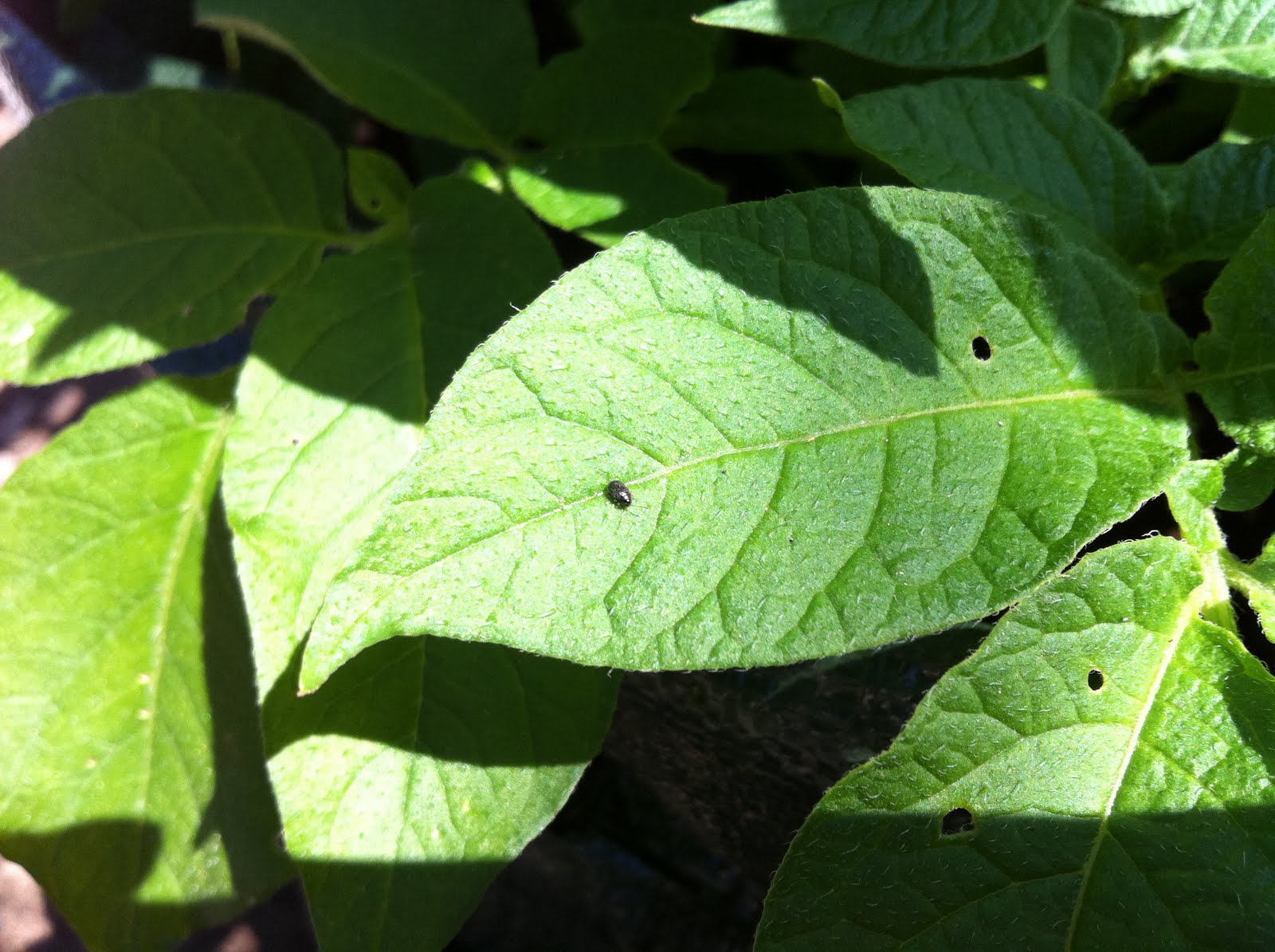
This weekend, I noticed small holes chewed in my potato plants. Whenever I see holes chewed in leaves, I immediately think 'it must be a beetle'. In fact, loopers, armyworms, cutworms and grasshoppers also chew holes in leaf tissue. However, the small, tiny holes in my potatoes were a clear indication that flea beetles were to blame. Flea beetle damage has been described as a leaf looking like it has been shot with several shots from a bb gun (albeit, very small bb's). Whitney Cranshaw describes the damage as looking like the leaves have been hit by fine buckshot - but not knowing what buckshot is, I default to my past experience with bb's. This is very different than the wholesale destruction (often called 'skeletonization') caused by loopers, armyworms and cutworms. It is also different than the large 'chomps' taken from leaves by grasshoppers.

It didn't take me too long to locate the offending chewers. Flea beetles are small and black. When disturbed, they jump off of the leaf much like a flea might jump from a dog. Flea beetles, however, are not blood suckers. They're leaf chewers that locate their host plants using the chemical cues that the plants emit.

Herein lies my problem. I prefer not to use pesticides in the garden. This is a personal preference - due to my being (1) lazy and (2) cheap. I don't like to spend money on pesticides. I don't like to take the time it takes to calculate application rates. Although I love math, I try to keep my garden a math-free zone. Unfortunately, to judiciously use pesticides or fertilizers in the garden requires that I pull out a tape measure - document the area on which I will use the chemical(s) - carefully read the pesticide or fertilizer label - and then translate the area where I will use the chemical(s) to an amount that will come out of the container. I'm just not that motivated.

So what is the problem? Flea beetles are very, very, very, very (you get the idea) difficult to control. They're strong fliers. They locate their host plants by sensing ('smelling') the plants' chemical cues. Worse yet, research strongly suggests that some flea beetles can use the chemical cues in the plants on which they are feeding, to make an aggregation pheromone (Peng and Weiss 1992). This sets the poor gardener (e.g. me) up for failure. One male flea beetle lands on my potatoes and starts to feed. He incorporates the chemical constituents of the leaf tissue, and re-manufactures at least some of these into Axe Body Spray for beetles. Basically, he turns my poor potatoes into his singles bar. No wonder I noticed so many mating beetles on my potatoes this morning, despite my efforts to pick the plants clean just 12 hours earlier. Given this type of chemical wizardry, it would be virtually impossible for me to control the flea beetles by hand-picking them off of the leaves - my preferred pest control method.

Weighing my pest management options, I refer to the PNW Handbook, and look up the entry for flea beetles. The PNW Handbooks are what we use in the Oregon Master Gardener Program, for research-based and reviewed pest control options. The PNWs don't always list the full suite of cultural, physical and biological controls available. But, if chemicals are necessary (which they may be, to control the flea beetles on my potatoes), then the PNWs provide a list of reviewed products. From the list of home use products for flea beetles, I see that neem oil is listed. Neem oil is an organic pesticide that can be used to control a variety of insects and pathogens. Because it is an organic pesticide, it tends to degrade quicker in the environment, relative to synthetic pesticide options. (Please note that organic pesticides are still pesticides. Organic pesticides are not necessarily less toxic than synthetic options, and in some cases are more toxic.)

But, I'm not yet keen to use neem. This is my personal preference, and not my professional recommendation to other gardeners. My own aversion to using chemicals, at this time, is because along with the flea beetles that were feeding on the tops of my potato leaves, I found aphids feeding and giving birth on the underside of the leaves. During Master Gardener training classes, I've often lectured about the benefits of 'popping' aphids. Squish an aphid, and you magically attract parasitoid wasps. Akin to how male flea beetles can use a plant's chemistry to attract the ladies, parasitoid wasps are able to 'smell' the chemicals that are released when an aphid is crushed. Some species of aphids release alarm pheromones when they are crushed. The alarm pheromones send a signal to nearby aphids: 'Abandon ship! We've been found! Parachute to safety, or else be eaten!'. The cool thing about alarm pheromones is that parasitoid wasps, ladybugs and other aphid enemies can hone in on a group of aphids, using released alarm pheromones as a guide (Micha and Wyss 1996). Yesterday, I crushed aphids. Today, I found parasitoids crawling all over my potatoes. A coincidence? Probably not.

So I'm left with potato plants that are infested with flea beetles, and that also have a few aphids (the bad guys). But, these same plants have parasitoid wasps and ladybug eggs (the good guys).

I want to get rid of the bad guys, and will most likely need a chemical solution to take care of the flea beetles. But, even the organic option - neem oil - is known to have negative effects on parasitoids, ladybugs an other natural enemies (Lowery and Isman 1995). The same is true for other insecticides listed for control of flea beetle.

What will I do? Because: (1) my potato plants are relatively large, (2) my tolerance for damage is high, and (3) my aversion to garden math during non-working hours is even higher - I will continue to vigilantly hand pick pests off of my plants. But, if I appear to be losing the hand-picking battle, I'll pull out my calculator, work through garden algebra, and judiciously apply a pesticide on affected leaves. I'll follow label directions, will continue to scout my plants, and will turn to floating row covers to keep the beetles off of my plants while they're looking for places to feed and mate. Once the flea beetle danger has passed, I'll remove the row covers, and look forward to harvesting healthy spuds in the fall. Although, it's hard to predict when the flea beetle danger may pass, since there can be 2-3 generations per year in Western Oregon.

Wish me luck!

Figures

Top: Flea beetle and flea beetle damage (photo taken by: Gail Langellotto)
Middle: Parasitoid wasp (photo taken by: Gail Langellotto)
Bottom: Ladybug eggs (photo taken by: Steve Rhodaback)


References Cited

Lowery, D.T. and M.B. Isman. 1995. Toxicity of neem to natural enemies of aphids. Phytoparasitica 23: 297-306.

Micha, S.G. and U. Wyss. 1996. Aphid alarm pheromone (E)-B-farnesene: a host finding kairomone for the aphid primary parasitoid Aphidius uzbekistanicus (Hymenoptera: Aphidiinae). Chemoecology 7: 132-139.

Peng, C. and M. J. Weiss. 1992. Evidence of an aggregation pheromone in the flea beetle, Phyllotreta cruciferae (Goeze) (Coleoptera: Chrysomelidae). Journal of Chemical Ecology 18: 875-884.